
CLL17 is a Phase 3, noninferiority study comparing fixed-duration combination therapies to continuous IMBRUVICA® monotherapy1-3
Please review RESONATE™-2 data before exploring the CLL17 study.
RESONATE™-2 primary analysis4,5
Study Design: Phase 3, multicenter, open-label trial of 1L CLL/SLL patients (N=269) ≥65 years of age who were randomized 1:1 to IMBRUVICA® 420 mg once daily until disease progression or unacceptable toxicity (n=136) or chlorambucil (n=133) for up to 12 cycles. Patients with del17p were excluded.
Estimated 2-Year OS Rate
- 95% with IMBRUVICA® (95% CI: 89, 97) vs 84% with chlorambucil (95% CI: 77, 90)
- HR=0.44 (95% CI: 0.21, 0.92) (secondary endpoint)
- Median follow-up: 28.1 months
- 41% of chlorambucil-treated patients crossed over to IMBRUVICA® upon disease progression
Estimated 18-Month PFS Rate
- 90% with IMBRUVICA® vs 52% with chlorambucil
- HR=0.16 (95% CI: 0.09, 0.28); P<0.001 (IRC-assessed primary endpoint)
- Median follow-up: 18.4 months
- Median PFS with IMBRUVICA® was not estimable vs 18.9 months (95% CI: 14.1, 22.0) with chlorambucil
ARs Reported in ≥15% of IMBRUVICA® Patients (≥4% for ARs Grade 3 or Higher)
- Diarrhea
- Musculoskeletal pain*
- Fatigue
- Nausea
- Cough
- Rash*
- Peripheral edema
- Bruising*
- Upper respiratory tract infection
- Dry eye
- Pyrexia
- Constipation
- Arthralgia
- Skin infection*
- Pneumonia*
- Hypertension*
Includes multiple ADR terms.
CLL17: Investigator-initiated, international, noninferiority,
randomized phase 3 trial for patients with TN CLL1-3
This is a prespecified interim analysis with still maturing follow up.
The CLL17 study is not included in the Prescribing Information for IMBRUVICA®.
Data are descriptive and provided for informational purposes.
The trial was designed to evaluate for noninferiority (limits claims of superiority/inferiority).
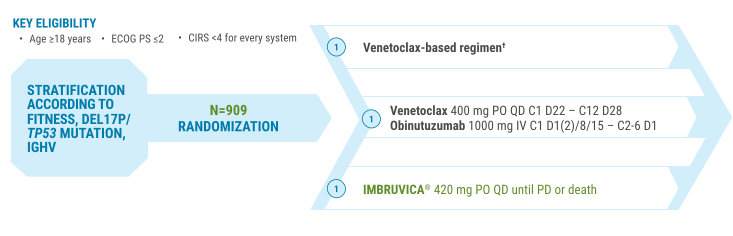
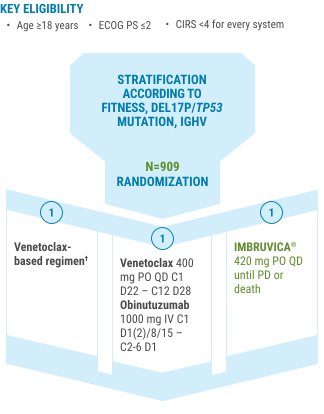
THE PRIMARY ENDPOINT WAS INVESTIGATOR-ASSESSED PFS, WITH AN NI MARGIN FOR HR OF 1.608 (CORRESPONDING TO AN NI MARGIN OF 8% AT 3 YEARS).
KEY SECONDARY ENDPOINTS WERE FINDINGS OF uMRD (<10−4 [<1 CLL CELL PER 10,000 LEUKOCYTES]) IN PERIPHERAL BLOOD AND BONE MARROW, CR, ORR, TTNT, OS, AND SAFETY.
Additional secondary endpoints were DOR, EFS, and PFS after 2L therapy.
CLL17 included stratified randomization and appropriate eligibility criteria.2
A per-protocol population was used as a sensitivity analysis to assess the robustness of the primary endpoint analysis.2
All patients of the ITT population were included and analyzed. Missing data were not replaced or imputed, but may have been censored.2
Fit patients were characterized by CIRS ≤6 points and GFR ≥70 mL/min, while unfit patients by CIRS >6 points and/or GFR <70 mL/min.2
Hypothesis testing for co-primary endpoints was planned to be performed simultaneously with statistical analysis and interpretation independently from each other.
†The study did not compare venetoclax-based regimen vs venetoclax + obinutuzumab.
Baseline patient characteristics including high-risk subgroups1
| IMBRUVICA® n=301 | Venetoclax + obinutuzumab n=303 | |
|---|---|---|
| Characteristic, % | ||
| Median age, yr (IQR) | 65 (59–72) | 66 (58–71) |
| Male sex, n (%) | 196 (65.1) | 216 (71.3) |
| CIRS score, median (IQR) | 3 (1–6) | 3 (1–6) |
| del17p and/or TP53 mutation, n/total n (%) | 21/300 (7.0) | 23/303 (7.6) |
| Unmutated IGHV, n (%) | 171/297 (57.6) | 171/300 (57.0) |
| Complex karyotype (≥3 aberrations), n/total n (%) | 58/265 (21.9) | 42/265 (15.8) |
PFS outcomes from CLL171
Data Limitations
- CLL17 efficacy results are not included in the Prescribing Information for IMBRUVICA®2
- The open-label nature of the study could introduce bias3
- Racial/ethnic demographics may be skewed by an all-European trial3
- This is an interim analysis with still maturing follow up (median observation time was 34.2 months)1
- Median follow-up was 34.2 months for both treatment arms1
- Median 3-year PFS was 81.0% for IMBRUVICA® vs 81.1% for venetoclax + obinutuzumab1
- Upper limit of adjusted CI below predefined margin, supporting noninferiority (HR=1.608)1
![PFS outcomes from CLL17: line chart of cumulative survival vs months for IMBRUVICA® and venetoclax + obinutuzumab. HR=0.87, 98.3% CI [0.54, 1.41]. Estimated 3-year PFS rate: 81.0% with IMBRUVICA® and 81.1% with venetoclax + obinutuzumab.](/images/cll/efficacy/_optimized/cll-efficacy-resonate-2-cll17-study-pfs-outcomes-opt-2048.WEBP)
![PFS outcomes from CLL17: line chart of cumulative survival vs months for IMBRUVICA® and venetoclax + obinutuzumab. HR=0.87, 98.3% CI [0.54, 1.41]. Estimated 3-year PFS rate: 81.0% with IMBRUVICA® and 81.1% with venetoclax + obinutuzumab.](/images/cll/efficacy/_optimized/cll-efficacy-resonate-2-cll17-study-pfs-outcomes-mob-opt-1920.WEBP)
PFS outcomes in del17p/TP53 patients1,3,6
Data Limitations
- CLL17 efficacy results are not included in the Prescribing Information for IMBRUVICA®2
- The open-label nature of the study could introduce bias3
- Racial/ethnic demographics may be skewed by an all-European trial3
- This is an interim analysis with still maturing follow up (median observation time was 34.2 months)1
- CLL17 was not designed or powered to establish superiority or to provide treatment recommendations for high-risk subgroups. Subgroup analyses are exploratory and should be interpreted with caution1
- Median follow-up was 34.2 months for all treatment arms1
- PFS in high-risk subgroups was a prespecified exploratory endpoint2
![PFS outcomes in del17p/TP53 patients: line chart of cumulative survival vs months across 4 subgroups — IMBRUVICA® del17p/TP53, IMBRUVICA® none, venetoclax + obinutuzumab del17p/TP53, venetoclax + obinutuzumab none. HR=1.20, 95% CI [0.40-3.59], venetoclax + obinutuzumab vs IMBRUVICA® in del17p/TP53 subgroups. Estimated 3-year PFS rates: 79.4% IMBRUVICA® del17p/TP53, 81.0% IMBRUVICA® none, 62.0% venetoclax + obinutuzumab del17p/TP53, 82.7% venetoclax + obinutuzumab none.](/images/cll/efficacy/_optimized/cll-efficacy-resonate-2-cll17-study-pfs-outcomes-in-del17p-opt-2048.WEBP)
![PFS outcomes in del17p/TP53 patients: line chart of cumulative survival vs months across 4 subgroups — IMBRUVICA® del17p/TP53, IMBRUVICA® none, venetoclax + obinutuzumab del17p/TP53, venetoclax + obinutuzumab none. HR=1.20, 95% CI [0.40-3.59], venetoclax + obinutuzumab vs IMBRUVICA® in del17p/TP53 subgroups. Estimated 3-year PFS rates: 79.4% IMBRUVICA® del17p/TP53, 81.0% IMBRUVICA® none, 62.0% venetoclax + obinutuzumab del17p/TP53, 82.7% venetoclax + obinutuzumab none.](/images/cll/efficacy/_optimized/cll-efficacy-resonate-2-cll17-study-pfs-outcomes-in-del17p-mob-opt-1920.WEBP)
Selected ARs ≥10% reported in CLL171
| Safety population | IMBRUVICA® (N=298) | Venetoclax + obinutuzumab (N=295) | ||
|---|---|---|---|---|
| All Grades, n (%) | Grade 3 or higher, n (%) | All Grades, n (%) | Grade 3 or higher, n (%) | |
| Blood or lymphatic system disorder | 85 (28.5) | 49 (16.4) | 174 (58.9) | 135 (45.8) |
| Anemia | 35 (11.7) | 13 (4.4)‡ | 47 (15.9) | 18 (6.1)‡ |
| Neutropenia | 35 (11.8) | 25 (8.4)‡ | 131 (44.4) | 108 (36.6) |
| Thrombocytopenia | 12 (4.0)‡ | 2 (0.6)‡ | 54 (18.3) | 27 (9.2)‡ |
| Cardiac disorder | 103 (34.6) | 34 (11.4) | 41 (13.9) | 13 (4.4)‡ |
| Atrial fibrillation | 50 (16.8) | 12 (4.0)‡ | 11 (3.7)‡ | 2 (0.7)‡ |
| Cardiac failure‡ | 11 (3.7) | 9 (3.0) | 1 (0.3) | 1 (0.3) |
| Gastrointestinal disorder | 189 (63.4) | 23 (7.7)‡ | 176 (59.6) | 16 (5.4)‡ |
| Diarrhea | 104 (34.9) | 7 (2.3)‡ | 80 (27.1) | 5 (1.7)‡ |
| Infection or infestation | 238 (79.9) | 74 (24.8) | 225 (76.3) | 103 (34.9) |
| COVID-19 | 117 (39.3) | 20 (6.7)‡ | 113 (38.3) | 47 (15.9) |
| Pneumonia | 40 (13.4) | 22 (7.4)‡ | 41 (13.9) | 29 (9.8)‡ |
| Laboratory investigation | 81 (27.2) | 30 (10.1) | 117 (39.7) | 54 (18.3) |
| Neutrophil count decreased‡ | 19 (6.4) | 16 (5.4) | 29 (9.8) | 25 (8.5) |
| Metabolism or nutrition disorder | 72 (24.2) | 10 (3.4)‡ | 90 (30.5) | 25 (8.5)‡ |
| Tumor lysis syndrome‡ | 1 (0.3) | 1 (0.3) | 12 (4.1) | 12 (4.1) |
| Musculoskeletal or connective tissue disorder | 169 (56.7) | 21 (7.0)‡ | 111 (37.6) | 12 (4.1)‡ |
| Neoplasms benign, malignant, and unspecified | 55 (18.5) | 26 (8.7)‡ | 34 (11.5) | 19 (6.4)‡ |
| Nervous system disorder | 103 (34.6) | 10 (3.4)‡ | 103 (34.9) | 12 (4.1)‡ |
| Skin or subcutaneous tissue disorder | 166 (55.7) | 10 (3.4)‡ | 87 (29.5) | 2 (0.7)‡ |
| Vascular disorder | 124 (41.6) | 31 (10.4) | 60 (20.3) | 14 (4.7)‡ |
| Hypertension | 72 (24.2) | 28 (9.4)‡ | 34 (11.5) | 10 (3.4)‡ |
‡AR <10%.
Causes of death reported in CLL171
| IMBRUVICA® | Venetoclax + obinutuzumab | |
|---|---|---|
| Infection | 3 | 12 (7 COVID-19) |
| Cardiovascular | 5 | 5 |
| Progression of disease/ Richter’s transformation | 0 | 1 |
| Second primary malignancy | 2 | 4 |
| Other | 4 | 0 |
| Total | 14 | 22 |
Overall survival is an exploratory endpoint which is descriptive in nature.2
Abbreviations
1L=first-line, 2L=second-line, ADR=adverse drug reaction, AR=adverse reaction, C=cycle, CIRS=chronic inflammatory response syndrome, Clb=chlorambucil, CLL=chronic lymphocytic leukemia, COVID‑19=coronavirus disease 2019, CR=complete response, D=day, del=deletion, DOR=duration of response, ECOG PS=Eastern Cooperative Oncology Group Performance Status, EFS=event-free survival, FD=fixed duration, f/u=follow-up, GFR=glomerular filtration rate, HR=hazard ratio, IGHV=immunoglobulin heavy-chain variable region gene, IV=intravenous, IRC=independent review committee, ITT=intention-to-treat, iwCLL=International Workshop on Chronic Lymphocytic Leukemia, NCI=National Cancer Institute, NI=noninferiority, ORR=overall response rate, OS=overall survival, PD=progression of disease, PFS=progression-free survival, PO=orally, QD=once daily, SLL=small lymphocytic lymphoma, TN=treatment-naïve; TP53=tumor protein p53, TTNT=time to next treatment, uMRD=undetectable minimal residual disease.